
A living work of art
The Amsterdam Rainbow Dress is a monumental artwork created from the national flags of countries where LGBTQIA+ people are criminalised or denied fundamental rights.
Whenever a country adopts legislation that advances LGBTQIA+ equality, its flag is removed from the Dress and replaced with a rainbow flag. The artwork therefore evolves alongside global developments, transforming legal change into a visible act of progress.
The Dress serves as both a celebration of freedom and a reminder that equality remains out of reach for millions of people worldwide.
How it began
The Amsterdam Rainbow Dress was created in 2016 by Mattijs van Bergen, Jochem Kaan, Arnout van Krimpen and Oeri van Woezik.
Originally unveiled during EuroPride Amsterdam, the Dress was created to make the global reality of LGBTQIA+ rights visible in a single image.
What began as a temporary artistic intervention quickly grew into a long-term international projects.
Rooted in Amsterdam
Amsterdam remains the home of the Dress and the city from which the project operates internationally.
In 2017, the Amsterdam Rainbow Dress became part of the collection of the Amsterdam Museum, recognising its significance as both a cultural and social landmark.
A symbol that evolves
The Amsterdam Rainbow Dress is not a static monument.
Every rainbow flag added represents progress. Every remaining national flag reminds us that the struggle for equality continues.
As the world changes, the Dress changes with it.
What does the Amsterdam Rainbow Dress stand for?
The use of international flags, rainbow flags and the Amsterdam city flag underlines the importance of Amsterdam remaining open to LGBTIQ+ refugees and migrants who have been persecuted in their country because of who they are or whom they love. On a national, continental and global level, for centuries Amsterdam has been an LGBTIQ+ safe haven, but this status must be cultivated and safeguarded for future generations, ensuring the city maintains this status. As the dress travels around the world we hope to extend this notion to other cities and communities, advocating for worldwide and multi-layered inclusivity and tolerance.
As a transgender woman, top model Valentijn de Hingh (pictured in the image above) knows better than anyone how to convey this message. She presented the Amsterdam Rainbow Dress to the public at the Amsterdam Museum and also modelled the dress in the stunning publicity photos shot by photographer Pieter Henket at the Rijksmuseum in the summer of 2016. These photos were shot in the Gallery of Honour, in front of Rembrandt’s Night Watch.
The Rijksmuseum, the Gallery of Honour and the Night Watch are considered iconic and representations of both Amsterdammer as well as Dutch identity and heritage. By photographing at this specific site, these pictures underline the history of Amsterdam as an enclave of freedom. In the image below, Valentijn de Hingh poses as the maid of Amsterdam, welcoming 180 nationalities to her hometown.
During an LGBTIQ+ focused mission the Amsterdam Rainbow Dress travelled from the Dutch capital to San Francisco with Amsterdam deputy mayor Simone Kukenheim where, with the support of the Netherlands General-Consulate, we created a second set of photographs underlining the importance of awareness with regards to state-sponsored homophobia and those affected by it.
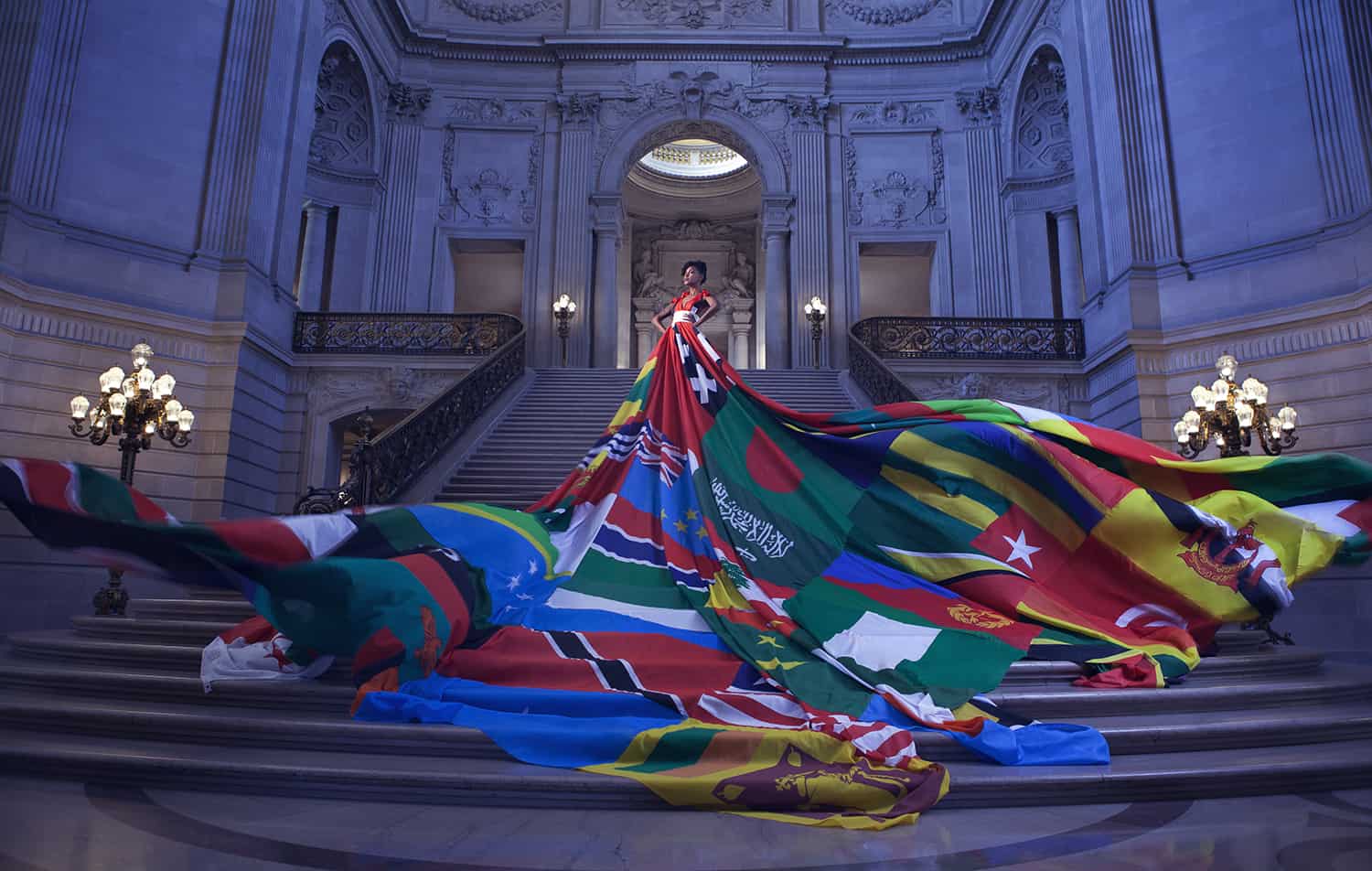
Set in San Francisco City Hall’s grand rotunda to mark Harvey Milk Day 2017, acclaimed photographer Ashlynn Danielsen captured top model Glo Taylor (in the image above) as she embodies the guardian of strength, resilience and progressiveness of San Francisco’s community. With the help of an LGBTIQ+ crew from the Bay Area, this production emphasizes the Amsterdam Rainbow Dress’ role as a beacon for the international LGBTIQ+ community.
Presentation and comments
On Friday, August 5th, 2016, the Amsterdam Rainbow Dress was first presented in the courtyard of the Amsterdam Museum. The accompanying art photographs, shot by acclaimed photographer Pieter Henket with LGBT+ activist and transgender top model Valentijn de Hingh, have since been widely published by international media; within a week the stunning images went viral on various platforms and got picked up by written press and television stations worldwide. These publications include Dutch national newspaper Het Parool, Huffington Post, El Pais, the Independent, USA Today, Art Daily, Vogue, Cosmopolitan, BuzzFeed, the Gaily Grind, Upworthy, the Guardian and CTV News Channel. As a result, the Amsterdam Rainbow Dress gained further attention from the Netherlands to China, from Australia to Brazil and the United States to the United Kingdom. In countries that were included in the dress at the time, such as India and Malaysia, heated online discussion was initiated as a result.
In September 2016, the Amsterdam Rainbow Dress joined an important arts and culture mission to New York City, led by Amsterdam deputy mayor Kajsa Ollongren. The mission was aimed at promoting Dutch culture, design and art in the Big Apple, with a total of 112 delegates representing 66 organizations and 12 start-ups.
In May 2017, the Amsterdam Rainbow Dress Foundation was invited by the Netherlands Ministry of Foreign Affairs to join a program with the Equal Rights Coalition on the annual International Day Against Homophobia, Lesbophobia, Biphobia and Transphobia (IDAHOT). With all ambassadors from the Coalition, foreign minister Bert Koenders and a group of LGBTIQ+ activists, allies and additional prominent guests and speakers present, the Amsterdam Rainbow Dress was presented at the ministry in The Hague, preceding a discussion on current LGBT+ affairs.
Also in May 2017, the Amsterdam Rainbow Dress Foundation joined an LGBTIQ+ focused mission from Amsterdam deputy mayor Simone Kukenheim, traveling to San Francisco to tighten bonds, establish dialogues and exchange knowledge, experience and awareness within the fields of art, healthcare, law enforcement, education, politics and business.
* List of countries as comprised by the International Lesbian, Gay, Bisexual, Trans and Intersex Association (ILGA). The flag of Angola, Belize, India, Trinidad and Tobago and Botswana have since been replaced with rainbow flags, while the flag of Chad has been added. The Amsterdam Rainbow Dress in its current form consists of 72 national flags, 5 rainbow flags and 4 Amsterdam city flags.
Quick links:
An up-to-date list of all flags currently incorporated in the Amsterdam Rainbow Dress*
Image: Valentijn de Hingh presents the Amsterdam Rainbow Dress in the Gallery of Honour at the Rijkmuseum, in front of Rembrandt’s iconic Night Watch. Image by Pieter Henket Studio.
Image: Glo Taylor presents the Amsterdam Rainbow Dress in San Francisco City Hall on Harvey Milk Day 2017. Image by Ashlynn Danielsen